Gypsy Moth - Lymantria dispar
Phylum: Arthropoda - Class: Insecta - Order: Lepidoptera - Family: Erebidae
Description
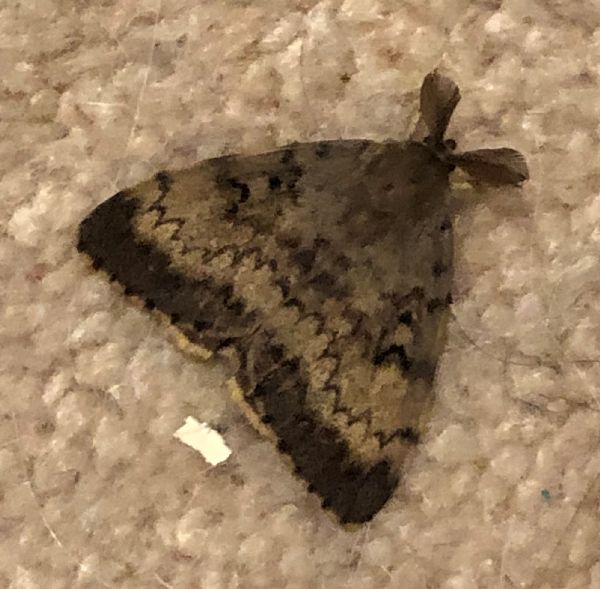
This fascinating moth is known as the Spongy Moth in the USA. The male, which has feathery antennae and brown wings patterened with darker brown wavy bands (sometimes with a greenish tinge), has a wingspan of 30 to 40 mm. Males are strong fliers.
Females, with a wingspan of 45 to 70mm are, much larger than the males. Their wings are white or cream with only very faint markings. With their large, heavy bodies, the females are flightless; they emit pheromones to attract their male partners.
The hairy larvae of the Gypsy Moth are dark brown or sometimes almost black, with five pairs of blue spots in front of six pairs of red spots.
Distribution
In Britain the Gypsy Moth was native to East Angia but became extinct at the end of the 19th Century. A reintroduction programme in 1995 saw breeding populations return to the London area and the species has since spread along the south coast as far as parts of Dorset.
This Eurasian moth species, also recorded in North Africa, is an alien intriduction in parts of eastern Canada and USA.
Habitat
Gypsy Moths favour broadleaved woodland, and they are sometimes found in parks, gardens and dense deciduous hedgerows.
Lifecycle
The females lay egg masses on the bark of deciduous trees (often oaks) or sometimes on leaf litter or even bare rock. These egg masses - each containing from 50 to several hundred eggs - are covered by a dense blanket of fuzzy tan hairs from the female's abdomen, and this helps them survide the winter frost. In spring the eggs hatch and tiny larvae emerge and climb up high, using fine threads of silk to float away on the breeze to a new feeding location. The larvae eat the leaves of trees and many other kinds of plants until, by mid-June, they are 50 to 90mm long and are ready to pupate.
The dark brown teardrop-shaped pupae are lodged into crevices in bark, wooden fenes, sheds, brickwork or leaf litter and take about two weeks to complete their metamorphosis. The winged adults can usually be seen in Britain during July and August.
Acknowledgements
This page includes pictures kindly contributed by Betty and Tony Rackham.
Studying butterflies and moths...

Excited by rivers and streams? So are we, and we're pretty sure you would find the Winding River Mystery trilogy of action-packed thrillers gripping reading too. Dead Drift, Dead Cert, and Dead End are Pat O'Reilly's latest river-based novels, and now they are available in ebook format. Full details on our website here...
Buy each volume in ebook format for only £2.47 on Amazon... Paperbacks also available on Amazon at £6.95 each. All proceeds go towards keeping the First Nature website online.
Please Help Us: If you have found this information interesting and useful, please consider helping to keep First Nature online by making a small donation towards the web hosting and internet costs.
Any donations over and above the essential running costs will help support the conservation work of Plantlife, the Rivers Trust and charitable botanic gardens - as do author royalties and publisher proceeds from books by Pat and Sue.